
How to Grow Soil with Meat and Potatoes
As most of our regular readers know, I, along with my wife Audra, own and operate Island Lake Farm, located east of Brainerd. It is a diverse farm operation with an abundance of different products, from various fruits, nuts, syrup, and lumber grown as part of our agroforestry systems, to livestock and veggies grown for market.

With a mission of using ecological principles in the production of food and forest products, conservation is at the heart of all we produce. One of the first conservation practices we started using some three decades ago was cover crops, or back then it was called green manure. These were plantings of mostly annual grasses and forbs (flowering plants) that were tilled in to build soil organic matter and natural fertility. We also did companion planting, and some years later we started to experiment with reduced tillage and longer crop rotations.
For the last decade or more we have focused most of our vegetable production on just a few crops that we grow for the market. For several years we had a four-year crop rotation and recently expanded to a six-year rotation.
Island Lake Farm has six garden plots that are approximately one-quarter of an acre each, for a total of one and a half acres in rotation. Each growing season we have one of the following crops grown in three of the plots, with the other three in perennial grasses and forbs.
We have a six-year crop rotation as follows:
Sweet corn and pumpkin/squash
Potatoes
Garlic / onions
Sunchoke incorporated into three years of perennial forage
We have found this to be an effective rotation as it helps to minimize disturbance, with most soil disturbance happening in years one and two, with no disturbance for four years. Here’s our approach in detail.
Year One: Corn and Pumpkins/Squash

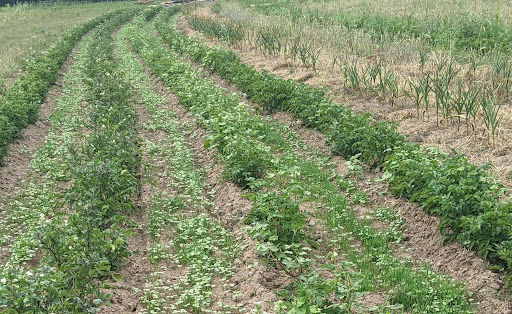
We begin the rotation by grazing hogs in late summer to break up sod and begin to prepare the soil. We use portable electric polywire fencing to contain the hogs. Once the hogs are removed, the field is lightly cultivated and an inexpensive cover crop is seeded, typically winter rye and red clover, with a mix of brassicas and annual ryegrass. After the ground freezes, large round bales are placed in rows 20’ on center and 30’ apart within the rows. They are “baled grazed” with cattle over winter, leaving behind two or three “rows” of spent hay and manure. Doing this on frozen ground prevents compaction, and over-wintering cover crops come in and fill the areas not covered with mulch.

The following spring, corn and pumpkins/squash are planted in the mulched rows. The layout is groups of two dozen corn seeds which are planted 6-8' apart. In between the corn seed groups, the pumpkins/squash are planted with 5-6 seeds per hill. In the fall, hogs are brought in to clean up the plot and glean any unharvested crop.

An option for those without livestock would be to “sheet mulch” rows in the fall by spreading composted manure in rows and covering with clean mulch 4-6” deep rows 3-4’ wide and 3-4’ apart. A cover crop is planted between the mulched rows. This should be done in mid-summer if not using hogs.
Year Two: Potatoes
The following season the plot is strip tilled and potatoes are planted 60-80” on center. We plant at 80” because my mower and tiller are 4’ wide. If a good cover crop from the previous season is established between the potato rows, we just mow it a few times a year to keep it from suppressing the potatoes. If a good cover crop is not established, the whole field is tilled and a cover crop seeded between the rows after the second hilling of the potatoes.
Our first potatoes are planted in early Spring, with our long-term storage potatoes planted in late June or early July. We begin digging potatoes in early July, and harvest up until our final storage potatoes in late fall. The disturbed areas where we harvest potatoes are mulched with clean straw right after harvest to suppress weed growth.
Year Three: Garlic/ Onions/ Shallots

Garlic is planted in the rows where potatoes were dug, around October first, typically in the rows where potatoes were harvested first. Garlic is planted in three rows 10” apart and 1’ apart within rows. The following spring we plant onions and shallots in the previous potato rows that weren’t planted to garlic in the fall. The mulch is raked back and they are planted in bunches of 4-6 for eating and storage onions and bunches of 10-12 for early scallions. As they grow they push apart and have plenty of room to grow. Like the garlic, they are planted in three rows approximately 10” apart and 1’ spacing in rows, but with the center row offset to give them a little more space. Having them offset also allows you to hoe at an angle from the side, making quick work of small weeds. We don’t mulch onions until they are well established as they like a lot of heat. Typically we have to hoe these once or twice before mulching. This is quick work if the weeds are small. I use a sharp stirrup hoe, and if properly spaced you can easily work between the rows at an angle, with very little hand weeding next to the onions or shallots. Once they reach 12-16” and the ground has warmed we mulch them.

Mow between the rows through the summer. I typically let it grow later in the year after the garlic is harvested in late July or early August. Harvest garlic scapes as they form, they make a great pesto, or we will dry them and grind it to make garlic salt. You can begin thinning scallions in mid to late June. To provide earlier onions, try winter bunching onions.
Year Four: Sunchokes
A new crop we recently added to the rotation is Sunchoke (also called Jerusalem Artichoke, though they aren’t native to Jerusalem and aren’t related to artichokes), a plant native to our region that grows an edible tuber. Last year we dug tubers from a few plantings of these we have around the farm, and planted them in the rows after harvesting garlic and onions. Our plan is to harvest these in year six before starting the rotation over. If we can’t find a market for them, we will turn them into bacon, as pigs love them!

Years Five and Six: Perennial Cover
These years the plot is allowed to grow. They tend to be very diverse, with the mix of seeding that happens voluntarily and that which we plant as part of our cover cropping system. If there are undesirable plants, such as non-native thistle or cockelbur, we will dig those by hand or, more often just chop and drop them before they go to seed. If possible we try to run chickens through these plots once or twice a season.
An Evolving System, One of Many
We believe our system goes a long way towards meeting the soil health principles. Soil disturbance happens primarily in the fall before year one, followed by a strip till in the spring of year two, and the potato harvest the same year. There is very little disturbance plating garlic and onions, or the sunchokes the following year. In fact, in the couple of months from when the first potatoes are harvested in early to mid July and the garlic is planted, we see soil aggregates rebuilding and worm tunnels reforming.
We keep the soil armored with mulch or vegetation and living roots in the ground the vast majority of the six years. Tillage is a tool we use, but try to use it sparingly, and then work to revegetate as soon as possible after a disturbance. Our crop rotation, use of diverse cover crops, and companion planting makes for a lot of diversity. And livestock are integrated throughout the system.
This is not a perfect system, and we will always be revising it, working to improve it, increasing efficiency and production. We have sold our cows, so bale grazing is off the table and we will be looking at the sheet mulch method next year. We hope to be able to run meat chickens on the paddocks to replace the fertility we’re losing with the cows. Getting the timing right on how long to leave the pigs in a paddock is always a challenge, getting the appropriate disturbance without compaction. Weed seed in the straw, or worse yet, straw that hasn’t been combined and still has the seed, can be a huge time vacuum if the garlic patch gets infested.

At Island Lake Farm we grow meat and potatoes intentionally. Both are most often grown in ways that require a lot of chemical inputs, and harm our soil and water. I was made aware of the amount of chemicals used in potato production a quarter century ago, and started growing them for our family, because that was our culture. I soon discovered unique varieties and how much more flavorful they were. The science suggests they are better for you as well. Audra is an exceptional caregiver, and we know that animals raised well benefit soil health, so they fit our operation. By using ecological principles, we are building the health of our soil, raising meat and potatoes that are clean and nutrient dense. And if you have meat and potatoes, garlic and onions are the next logical step.
Every farm is different and every farmer has different strengths and passions. Find what yours are, and work to develop systems that help to meet the soil health principals. Can you incorporate livestock into your system? If you are growing on plastic mulch, are there ways you can diversify the system to eliminate that from some of the crops you grow? Are there companion planting methods that can help diversify your system, or can you incorporate cover crop mixes into your system? Find a system that works towards building ecosystem health, and then strive to improve it through experimentation and observation.
I heard once that if a gardener is lucky they have approximately sixty chances to get it right, meaning a person might get sixty growing seasons to perfect their skills and system. I’m resigned to the fact that I will never “get it right.” If I did, then I wouldn’t need to experiment or try new methods or crops, which for me is half the reason I grow food.
Want to know more about sustainable living topics, events, and happenings? Sign up for Happy Dancing Turtle’s eNewsletter.


Comments