
Fire Has Its Season, But Managing Even Better
It’s fire season again, as are most spring seasons in the Midwest. This time the wakeup call came closer to the Northern Lakes campus of Happy Dancing Turtle in Pine River in May 2026. Wildfires are a concern statewide.
The 1600-acre Flanders fire burned in Mission township in north central Crow Wing County. Flanders Lake sits on the western end of several thousand acres of publicly owned land. That land surrounds the Pine River, just before it enters the Mississippi River. Much of the land was clearcut and planted to Norway (Red) Pine and is managed in various age classes.
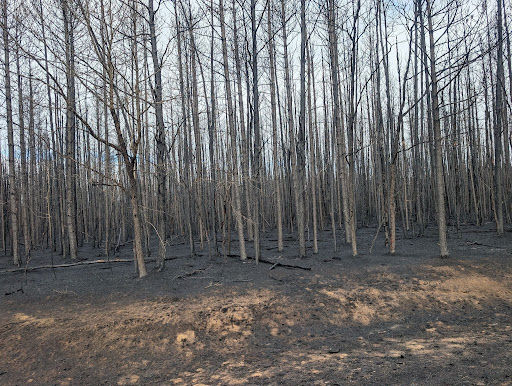
Thirty or forty years ago, when they first started converting this land to plantations, we’d go there after clearcuts and pick blueberries, abundant after disturbance. But soon the trees closed in and shaded out the blueberries. The plants were there, they just did not get enough light to produce fruit. The companies and agencies who manage these woodlands conducted prescribed timber harvests over the years, thinning the trees to increase tree growth and quality, with the goal of harvesting mature “crop” trees after 60-90 years of growth. Many of the trees they planted are now burned, most dead and likely unharvestable.
I’ve written a couple of times in the last few years about the role of fire in managing landscapes, first how indigenous people used fire to provide for their needs, and then how this traditional ecological knowledge can help reduce the chance of catastrophic wildfires like the recent Flanders fire.
Prescribed Burns
In 2017 the state legislature commissioned the Minnesota Prescribed Fire Council to complete a fire needs assessment to assess the prescribed fire needs based on the historical ecological context of the land. They found that statewide prescribed fire is needed on almost one million acres per year. It is estimated that Minnesotans currently burn 50,000 - 76,000 acres per year.
According to the Minnesota DNR Annual Report on Emergency Firefighting Expenditures for the fiscal year 2025 they expended $40,346,328 on state-led wildfire response, with the ten-year average being $28,778,521. If we invest up front in a more holistic approach to forest management, would it offset the cost to fight wildfires? I believe so, especially when you consider the possible loss of infrastructure and lives.
The soils where the Flanders Fire burned is glacial outwash, sandy soils left from glacial lake Aitkin and Brianerd. These drought-prone soils burned often before European colonization. A DNR botanist presenting at a conference some years ago said research estimates that these types of landscaped burned as often as every thirteen to thirty years. In my forty-plus years of living in this area, I don’t recall ever seeing a prescribed burn conducted in this area of the Flanders fire.

So what might this area look like if we took a different management approach? If fire was incorporated more often into our forested ecosystems there would be fewer trees and trees of all ages. Larger trees that have developed thicker bark and whose branches are high enough from the ground to prevent the fire moving to the canopy would be present, as well as younger trees, regenerating after the last burn.
Tree species would be more diverse with various fire-dependent species such as Jack pine, with their serotinous cones, bur oak, and white pine prominent on the landscape. Aspen, birch, and other mid-succession species would be in areas that held a bit more water, or had a north aspect and stayed a bit cooler and burned less often or intensely. The understory would be more abundant with fruit- and berry-producing plants that support more wildlife, from pollinators to birds. Browsing and grazing animals would be more prevalent with the abundant food supply. Overall biomass production and carbon sequestration would increase.
Prescribed Burn Benefits
This type of management would take a much different mindset than the current model which prioritizes productivity and efficiency. The cost accounting would need to consider more than just board feet per acre. Timber harvest could still take place, but less efficiently and fewer board feet per acre would be produced. Bird, insect, and browsing animal numbers would dramatically increase, opening up opportunities for wild harvest or fruit, nuts, and game. Any unplanned fires that did start would likely be less destructive due to a lack of ladder fuels that move fire into the forest canopy where it can spread rapidly and be more difficult to control.

I encourage you to learn more about the benefits of prescribed fire. If you agree we need more fire on the land, reach out to your elected officials and share your concern. If you own land, consult with the DNR, your local NRCS or SWCD office, or a private restoration company to see if fire is a fit for your land. And if you want to be more active, consider joining one of the many Prescribed Burn Associations forming around the state and country. PBA’s are made up of neighbors helping neighbors, a grassroots effort to safely get more fire on the land.
Want to know more about sustainable living topics, events, and happenings? Sign up for Happy Dancing Turtle’s eNewsletter.
Driftless Resources
The Prairie Enthusiasts organization has good information about prescribed burns and offers classes
Restoravore is an organization that focuses on land use practices that reintegrates communities with native ecology. Their blogs feature fire topics.


Comments