
In Search of the Perfect Turn
My parents owned a bakery when I was growing up. I fried donuts before school and helped out on weekends. Right out of high school I landed a job as an assistant baker at Ruttger’s Resort. I was laid off in the fall and had planned to spend the winter ice fishing and collecting unemployment, when my sister shared a contact at Keystone ski resort in Colorado from a friend of hers that had heard they needed bakers. I mailed my application on a Monday and on Friday I got a call from Steve, the contact, asking if I could start Monday, and asking if I was a skier. I asked if Wednesday would work for a start date, and told him no, that I’d only skied once at a local hill, Mount Ski Gull, but was anxious to learn.
I worked at Keystone for four winters, one season shortened by a family illness, and then transferred to Arapahoe Basin for two more seasons. I worked graveyards as a prep cook, making brownies from a bag, and soup and chili by the forty-gallon batch. This meant I could ski most any day I wanted, and I skied a lot.
One afternoon, my second or third season working there, after waking from never enough sleep, I was in the dormitory commons area when some guy came in and asked if I had a car. I said yes, and he asked if I wanted to go ski Montezuma Bowl. I said sure, where’s that? We parked my car a few miles down Montezuma road and then drove his car back around the ridge and several miles up the highway to Arapahoe Basin.
We took the two chairlifts needed to get to the top of the basin, catching one of the last chairs of the day to the top. We then ducked the rope and passed the ski resort boundary sign which basically said that you were leaving the ski area, that you were not allowed to return, that you were on your own if you got hurt or lost, and that you could die. We then proceeded boot pack (hiking in deep snow) up the final fifty vertical feet to the top of the ridge, around 13,000 feet in elevation.
When we had left Keystone an hour or so before, it was calm and sunny with water dripping from the eves. At the top of the ridge, well above treeline, it was blowing snow, biting cold, and I was underdressed. My new friend clicked into his skis and took off down the untouched powder, making several smooth turns and coming to a stop. I slid over the ridge, took one turn then proceeded to faceplant as I broke unexpectedly through a hard crust layer. The snow was so deep I didn’t know which way was up. I struggled to surface and get upright and then to get my skis back on. The whole time my new friend was hollering at me to hurry up. I had snow down my jacket and in my gloves, and fingers and ears were starting to go numb. I had also spent enough time in the woods to know I was burning daylight.
I took one more wipe out before I figured out I needed to intentionally bust through the crust on every turn. After descending a couple hundred feet in elevation, the snow got softer, the skiing became easier, and I began to link some turns. By the time we got to the treeline, I was hooked on backcountry skiing.

I had grown to love skiing–the smoothness of a fresh groomer, or the challenge of riding moguls. Studies have shown the rhythm of the ski turn is the perfect motion to trigger chemicals in the mind that make you happy. But now, I was skiing in the wilderness, a place I knew from a youth of camping, fishing, and canoeing. And in the backcountry, there were fresh ski tracks to be found, the slopes an untouched canvas to paint. Backcountry, fresh tracks, and quietness. From then on I took every opportunity to get out of bounds, always seeking fresh powder.
Micheal Beavers was the sous chef who taught how to make soup and chili when I first began working at Keystone. A big, laid back man from New Orleans, I still remember him standing over the large steam kettle with a big smile on his face, unwrapping pounds of butter and throwing them in the pot. “It doesn’t really matter what soup you’ll is makin, yah always start with butta, oniuns, and gaarrlic”, he claimed with a strong Louisiana drawl. It was sound advice that has never failed me. Michael wasn’t much of a skier, but when he skied he wanted to look good. Time and time again he spoke of “finding the perfect turn” – a turn that’s smooth and symmetrical, that you can look back at in the fresh snow and be proud. The kind of turn that sends the happy brain chemicals into overdrive.
Back in the Midwest – Not Backcountry But Not-bad Skiing
After several years working in Colorado, opening bags of brownie mix became too monotonous, and the transient lifestyle began to wear on me. Eventually I found year-round work in Minnesota, and skiing fell off my radar, in favor of family, farming, and running sled dogs. Skiing as I knew it didn’t exist in Minnesota. Fresh tracks and deep powder are hard to find here. I tried at first, chasing storms to Quadna Mountain, and boot packing the Cuyuna Range mine hills trying to find some turns, but the perfect turn seemed even more elusive. For close to twenty years I didn’t put on a pair of downhill skis.
Then our oldest, Michael, started snowboarding and planned a trip to Whitecap Mountain ski area, and invited his old man. I’d heard of good skiing and abundant snow in the UP, but I didn't understand the power of Gichi-gami. The moisture of the “Great Sea” collides with the cold air of the north and delivers abundant snowfall to the snowbelt of northern Wisconsin and the upper peninsula of Michigan. Often over 200 inches of cold, dry snow will fall in a season. And I was about to get a lesson on just how good it can be.
After upgrading from a regular rental ski to the latest performance model, it didn’t take me long to find the double black diamond runs under the Southpole Chairlift at Whitecap. St. George run is short, but steep, sweeping to the skiers left as it falls at a 35 - 40% slope, steep enough that one missed turn can get you into trouble. I dropped in and within a few turns, it all came back.
Skiing steep terrain requires staying forward on your skis so your tips engage early the turn. In practice it’s very counter intuitive, to lean further forward as the slope gets steeper, but when you get it right, it becomes almost effortless. There had been lots of snow that year and there was good coverage. The moguls were soft, I was forward on my skis, letting them do the work, falling down the slope by flipping my ski tails from side to side, I was once again hooked on the sport I’d let go.
The next year we went to Mount Bohemia. Located at the tip of the Keweenaw Peninsula, which juts some sixty miles into the waters of Lake Superior, it is a unique ski resort for many reasons. With a motto of “no beginners allowed,” Boho, as it’s called, has no green runs. They make no snow, and don’t groom anything. Being surrounded by water, they get an average of 270” of snow a year, more than many resorts in the Rocky Mountains.
While they have a few open treeless runs, much of the resort is gladed runs where the underbrush is cut and limbs pruned up, and tree skiing is encouraged. Despite being lift-served, it often has a feeling of being in the wilderness. My first run there was getting first tracks down Bohemia Bluffs with six inches of new snow. It was the first powder I’d skied in two decades, yet coming down through the hemlocks and pines that morning, I’m pretty sure I put down one or two perfect turns. We started taking annual family trips staying at the base area in rental yurts, and I began chasing storms out there whenever I could.
A couple of years later I was talking about my renewed ski addiction at a Sustainable Farming Association meeting, when a friend, Wayne Monson, mentioned a group he belonged to called the Minnesota Flatlanders, that took backcountry ski trips to the 10th Mountain Division Huts in Colorado. I signed up and took my first backcountry hut trip in 2018, some thirty years after I worked and skied in Colorado.

“10th Mountain is a 501(c)3 not-for-profit organization that manages a system of 38 backcountry huts in the Colorado Rocky Mountains, connected by 350 miles of suggested routes. We provide a unique opportunity for backcountry skiing, mountain biking, or hiking while staying in a secure, comfortable shelter.
Our name honors the men of 10th Mountain Division of the U.S. Army, who trained during World War II at Camp Hale in central Colorado. Hut visitors share the special spirit of these individuals, especially their pursuit of excellence, self reliance, and love of the outdoors.” 10th Mountain Division Hut Association website.
The 10th Mountain Division Hut Association carries on the legacy of its members. Many of the huts were built in honor of veterans of the 10th Mountain Division who were instrumental in several battles during WWII and also in later developing the sport ski industry in the US..At least 62 ski resorts in the US were started by veterans of the 10th Mountain Division, including Vail, Aspen, Arapahoe Basin, Sugarbush, and Mt. Bachelor.
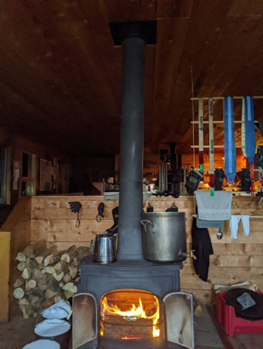
Much more than just “huts,” these remote cabins sleep from 6-20 people and come equipped with a bunk with mattress pad, wood heat (firewood provided), propane cookstoves and cooking utensils, and solar powered lights. Most of them have wood cook stoves with an oven, and a few have saunas, which is a nice treat. The bathroom is typically an outhouse. Most huts require a three to eight mile uphill ski to reach them and are located high in the mountains, often over 11,000’ in elevation near treeline. They all have spectacular views, with Skinner Hut having the best of the huts I’ve visited.
The gear has improved immensely since my early ski days. Wider skis with “rocker” tips and tails keep you on top of the snow and turn easier. Modern Alpine Touring skis allow you to release the heel of your ski boot when climbing, while your toe stays attached like a cross country ski. Ski skins attach to the bottom of your skis, allowing you to ski up slopes as steep as 20 degrees without slipping. Once at the top, you take off the skins, clip in your boot heel, and ski down. There are also split boards, which are snowboards and breakdown to two skis to climb, then connect back together to strap in and ride down the mountain.

More locally, I belong to a group called the Superior Highland Backcountry group, where they’ve gotten permission to glade runs on some public lands to enhance and promote backcountry skiing on the North Shore. Finland Glades is one of these areas. Located between the small town of Finland and Lake Superior, it boasts several gladed runs and a respectable (in Midwest standards) vertical drop of over 400.’

Unlike resort skiing, for me, backcountry skiing is more about the experience than the amount of vertical feet you ski. If you’ve earned your turns, they just mean more. My first trip was to Francie’s Cabin where we spent over three hours climbing a nearby ridge. The run was a total of 1400 vertical feet drop and took less than 20 minutes to ski down, with breaks. Then we had another half mile ski back to the cabin. On a good day, 10,000 vertical at a resort is easy. The backcountry isn’t easy.

Cooking in the backcountry is something I enjoy. We just returned from a hut trip in the first week of March, and I must say the pizza we baked in the wood oven turned out fantastic, as did the pineapple upside down cake.
I feel very fortunate to be a skier, and to ski backcountry in wild places. On this last trip, three of us got up before sunrise and hiked to the top of a small peak near the hut to catch the sunrise. It was clear and calm as we climbed the skin track up the mountain, the lights of Leadville twinkling south in the distance. The mostly full moon was setting in a dark sky to the west. We summited and took our places as we watched the sky slowly fill with light. Just as the sun broke the horizon, there was a gust of wind from the north and a large flock of small birds flew past us, singing as they flew. I made a pishing noise to try and call them back, and they circled back and round us before leaving us and taking the breeze with them.
Once the sun was up in the sky, we strapped in and headed down for breakfast. The snow had frozen hard after being soft the day before. It was fast, yet you could get an edge, and my turns felt smooth and symmetrical. I’m not sure any of those turns were perfect, but it was a perfect morning.
Want to know more about sustainable living topics, events, and happenings? Sign up for Happy Dancing Turtle’s eNewsletter.


Comments